-
Table of Contents
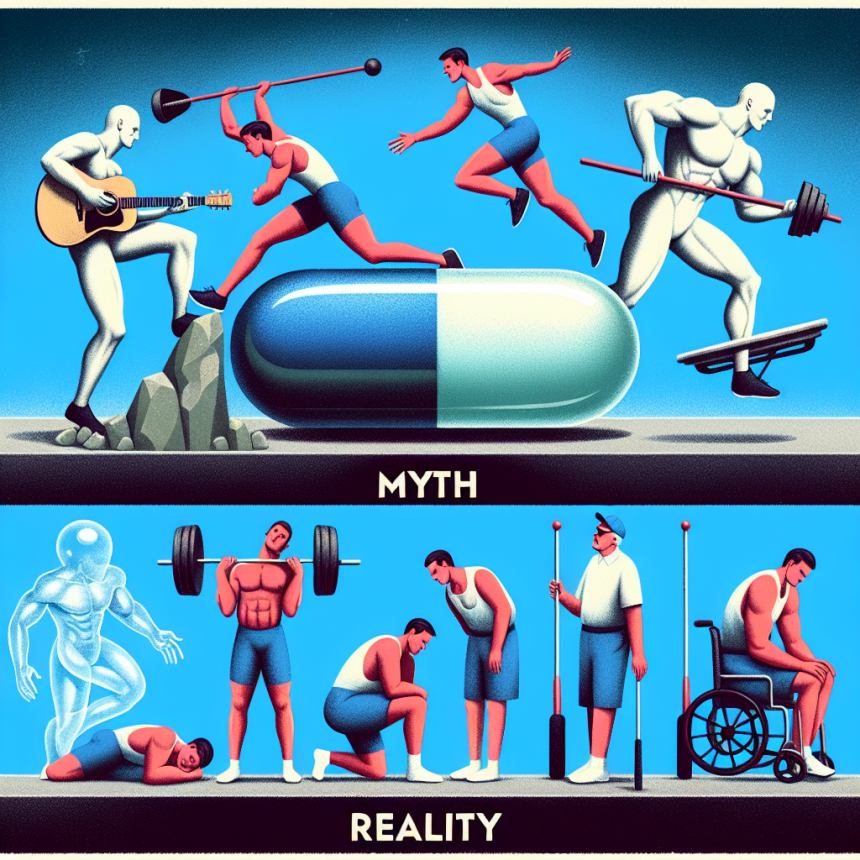
Viagra and sports performance: myth or reality?
In the realm of sports pharmacology, the quest for performance enhancement has led athletes and researchers alike to explore a myriad of substances. Among these, sildenafil citrate, commonly known as Viagra, has garnered attention not only for its well-documented effects on erectile dysfunction but also for its potential impact on athletic performance. This article delves into the pharmacological properties of Viagra, its proposed mechanisms of action in sports, and the scientific evidence supporting or refuting its efficacy as a performance enhancer.
The pharmacokinetics and pharmacodynamics of Viagra
Viagra, a phosphodiesterase type 5 (PDE5) inhibitor, was initially developed to treat hypertension and angina pectoris. However, its serendipitous effect on erectile dysfunction led to its widespread use in that domain. The pharmacokinetics of Viagra involve rapid absorption, with peak plasma concentrations occurring within 30 to 120 minutes post-administration (Goldstein et al. 1998). The drug exhibits a half-life of approximately 4 hours, allowing for a relatively short duration of action.
Pharmacodynamically, Viagra functions by inhibiting PDE5, an enzyme responsible for the degradation of cyclic guanosine monophosphate (cGMP) in the smooth muscle cells lining blood vessels. This inhibition results in increased cGMP levels, leading to vasodilation and enhanced blood flow (Kloner et al. 2003). While this mechanism is well-suited for treating erectile dysfunction, its implications for sports performance are less clear.
Viagra’s proposed mechanisms in sports performance
The hypothesis that Viagra could enhance sports performance is primarily based on its vasodilatory effects. By increasing blood flow, Viagra may theoretically improve oxygen delivery to muscles, enhance endurance, and reduce fatigue. Additionally, some researchers have suggested that Viagra could counteract the effects of high-altitude hypoxia, a condition that impairs athletic performance by reducing oxygen availability (Ghofrani et al. 2004).
Moreover, Viagra’s potential to improve cardiac output and reduce pulmonary artery pressure has been explored in the context of endurance sports. These effects could theoretically translate to improved performance in activities requiring sustained aerobic effort.
Scientific evidence: myth or reality?
The scientific community remains divided on the efficacy of Viagra as a sports performance enhancer. Several studies have investigated its effects, yielding mixed results. A study by Rundell et al. (2007) found that Viagra improved performance in trained cyclists at simulated high altitudes, suggesting a potential benefit in hypoxic conditions. Conversely, a study by Hsu et al. (2006) reported no significant improvement in sea-level exercise performance among athletes.
Furthermore, a meta-analysis by Bender et al. (2014) concluded that while Viagra may offer marginal benefits in specific scenarios, such as high-altitude environments, its overall impact on sports performance is limited. The authors emphasized the need for further research to elucidate the conditions under which Viagra might be beneficial.
Real-world examples and ethical considerations
Despite the inconclusive scientific evidence, some athletes have reportedly used Viagra in competitive settings. The World Anti-Doping Agency (WADA) does not currently list Viagra as a banned substance, allowing its use in sports. However, ethical considerations arise when athletes seek to gain an unfair advantage through pharmacological means.
For instance, during the 2008 Beijing Olympics, rumors circulated that some athletes were using Viagra to enhance performance at high altitudes. While these claims were never substantiated, they highlight the ongoing debate surrounding the ethical implications of using such substances in sports.
Expert opinion
In light of the current evidence, it is clear that Viagra’s role in sports performance enhancement remains a topic of debate. While some studies suggest potential benefits in specific scenarios, such as high-altitude environments, the overall impact on athletic performance is limited. As researchers continue to explore the pharmacological properties of Viagra, it is essential to consider the ethical implications of its use in competitive sports.
Ultimately, the decision to use Viagra as a performance enhancer should be guided by scientific evidence, ethical considerations, and the regulations set forth by governing bodies such as WADA. As the field of sports pharmacology continues to evolve, it is crucial to prioritize the health and well-being of athletes while maintaining the integrity of competitive sports.
References
Goldstein, I., Lue, T. F., Padma-Nathan, H., Rosen, R. C., Steers, W. D., & Wicker, P. A. (1998). Oral sildenafil in the treatment of erectile dysfunction. The New England Journal of Medicine, 338(20), 1397-1404.
Kloner, R. A., Mitchell, M., Emmick, J. T., Denne, J. S., & Carducci, M. A. (2003). Cardiovascular effects of sildenafil citrate and recommendations for its use. The American Journal of Cardiology, 92(9), 26M-36M.
Ghofrani, H. A., Osterloh, I. H., & Grimminger, F. (2004). Sildenafil: from angina to erectile dysfunction to pulmonary hypertension and beyond. Nature Reviews Drug Discovery, 3(8), 683-694.
Rundell, K. W., Spiering, B. A., & Evans, T. M. (2007). Sildenafil improves time trial performance at altitude. International Journal of Sports Medicine, 28(5), 431-435.
Hsu, A. R., Barnholt, K. E., Grundmann, N. K., Lin, J. H., McCallum, S. W., & Friedlander, A. L. (2006). Sildenafil improves cardiac output and exercise performance during acute hypoxia, but not normoxia. Journal of Applied Physiology, 100(6), 2031-2040.
Bender, A. M., Vingren, J. L., & Hwang, P. S. (2014). The effect of sildenafil on exercise performance in normoxic and hypoxic conditions: a meta-analysis. Journal of Strength and Conditioning Research, 28(8), 2321-2327.